Historical Names - Southeastern Bayous
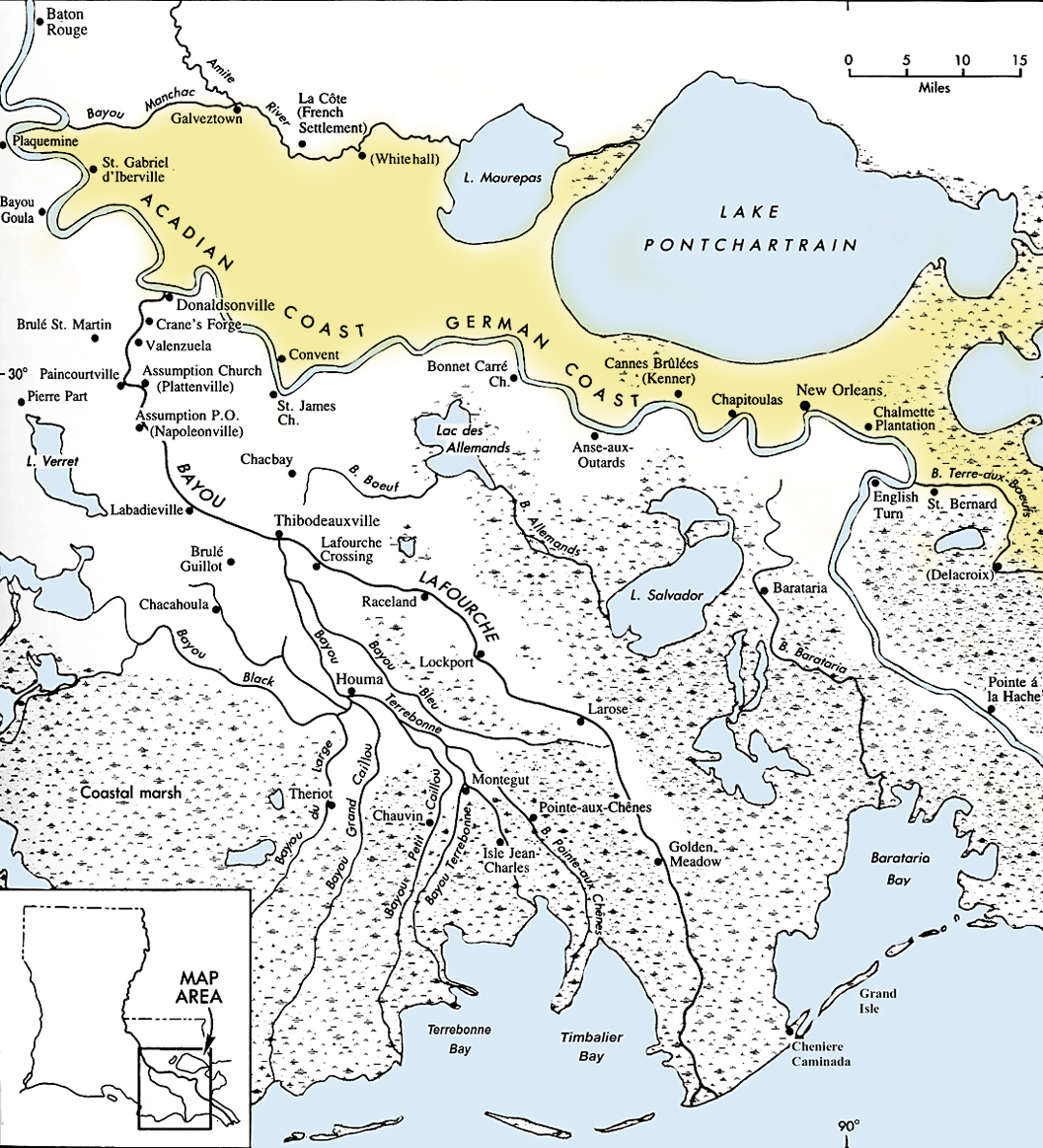
Map of the southeastern Bayou region from West, Atlas of LA Surnames, page 5, figure 3.
The area shaded in yellow is the Isle of Orleans, which was the object of President Jefferson's original proposal to purchase New Orleans from France.
For translations, see Father Daigle's Dictionary of the Cajun Language or any French-speaking Cajun; for Indian names, see Kniffen et al., Indian Tribes of LA:
Allemands means Germans; des Allemands, of the Germans
amité means friendly or kind
anse means cove
Anse-aux-Outards means cove of the Canada geese; its location on the map is misleading; the settlement actually was on the left, or east, bank of the river across from Bonnet Carré
Baton Rouge means red stick or pole
bayou, a Choctaw word meaning slow-ass stream, is a small river surrounded by wetlands and is sometimes spelled baillou in old records
bleu means blue
boeuf means ox or beef
Bonnet Carré means square bonnet or hat
brûlé means burnt; it's sometimes spelled with an extra "e" at the end
caillou means gravel or pebble
Cannes Brulées means burnt reeds or canes
Chacahoula is an Indian name
Chacbay is probably another Indian name, also spelled Chackbay
Chapitoulas or Tchopitoulas, pronounced CHOP-uh-too-lus as if the "t" is missing, is an Indian name
Chauvin is a French Creole family name
chenière is a ridge in the coastal salt marshes with oak trees growing on it; chêne means oak
côte means hill or mound, also coast
du large means of the open sea or prairie, obviously the latter here; the bayou also is called au large; comme çi, comme ça
Gálvez was the Spanish governor of Louisiana during the late 1770s and early 1780s who attacked the British at Manchac, Baton Rouge, and Pensacola during the American Revolution; his name was Bernardo de Gálvez or Gálves; Galveston, Texas, is also named after him
Bayou Goula is from an Indian nation, the Bayougoula, who lived on the site of the town of that name and whose name in Choctaw means "bayou people"
Guillot, pronounced GEE-yot, is an Acadian and French-Creole family name
haché means hand ax
Houma comes from the Indian nation that once lived in the Yazoo region of Mississippi but moved to the bayous of southeastern Louisiana before the Acadians arrived; their descendants still live in the southeastern bayou area; their name is from the Muskogean term chakchiuma, which means "red crawfish" or "people of the red crawfish"
Iberville, whose full name was Pierre LeMoyne, sieur d'Iberville, was the French-Canadian soldier and explorer of the late 1690s and early 1700s who founded the French colony of Louisiana
isle means island
Labadie is a French-Creole family name, often spelled Abadie
la fourche means the fork or branch
Manchac comes from the Choctaw Indian word imashaka, which means "behind it" or "to the rear"
Maurepas was a French nobleman, Jérôme Phélypeaux, comte de Maurepas, French Minister of Marine and a prominent figure in the settlement of Louisiana; he was, in fact, the son of Pontchartrain
Montegut means high mountain; the town is named after Gabriel Montegut, former director of the mint in New Orleans who moved to Terrebonne Parish; the name is pronounced mon-tuh-GYU as though it were spelled "Montague"
Orléans is a city in central France; Jean-Baptiste Le Moyne, sieur de Bienville, the city's founder, named New Orleans after Philippe, duc d'Orléans, regent of France, not the city in France
Outarde is a Canada goose
Paincourtville means shortbread town
Pierre Part, pronounced Pee-AIR PARR, the "t" being silent, is the name of an Acadian settler who lived in what is now northwestern Assumption Parish; it's also the home of alligator hunter Troy Landry of History channel's popular "Swamp People" program
plaquemine means persimmon
Plattenville could mean low-lying place since platin means low area of land; Platten also is the name of a family, probably French Creole, who lived in the area
Pointe-à-la-Haché means point of the hatchet or perhaps point that was cut off, as with a hatchet
Pointe-aux-Chênes means point of the oaks
Ponchartrain was the French minister, Louis, comte de Maurepas, comte de Pontchartrain, who encouraged the settlement of Louisiana
salvador is Spanish for savior
Terrebonne means good earth and is a French-Creole family name
Terre-aux-Boeufs means land of the oxen or beef cattle
Theriot is a prominent Acadian family
Thibodeaux, or Thibodaux more properly here, is another prominent Acadian family; the town of Thibodauxville, later Thibodeaux, now Thibodaux, was named after the political leader who served briefly as governor, Henry Schuyler Thibodaux of Terrebonne Parish, who may have been an Acadian who emigrated to Louisiana from Canada
Valenzuéla is a Spanish family name; the village on the upper Bayou Lafourche was created in 1779 for Isleños from the Canary Islands and was named by Spanish Governor Bernardo de Gálvez in honor of the family of one of his aunts
Verret is a French-Creole family name that may mean someone who works with glass